Product × Engineering · Visa · Tink
The acquisition that had to disappear.
Visa acquired Tink's Pay by Bank. My job was to make it feel like it had always belonged inside Unified Checkout — without erasing the trust customers already had in Tink.
- Role
- Lead designer, Unified Checkout
- Scope
- 6 European markets
- Partners
- Tink Design · Alt Payments · Regional
- Result
- Shipped, demoed to Barclays & partners
Two products, one journey
Tink came with its own customer journey, its own interaction patterns, its own brand guidance, its own regional requirements. Unified Checkout was the entry point, but the moment a customer chose Pay by Bank, they left it — moving into Tink's bank-selection and authentication flow before landing back on the merchant's checkout. Handled carelessly, that's not one payment journey. It's three disconnected handoffs wearing one product's name.
I owned the integration end to end: where Tink should lead the experience, where Unified Checkout patterns should take over, how the transition should read to someone who'd never heard of Tink, and how all of it should scale past the initial UK rollout.
A button that had to teach, not just launch
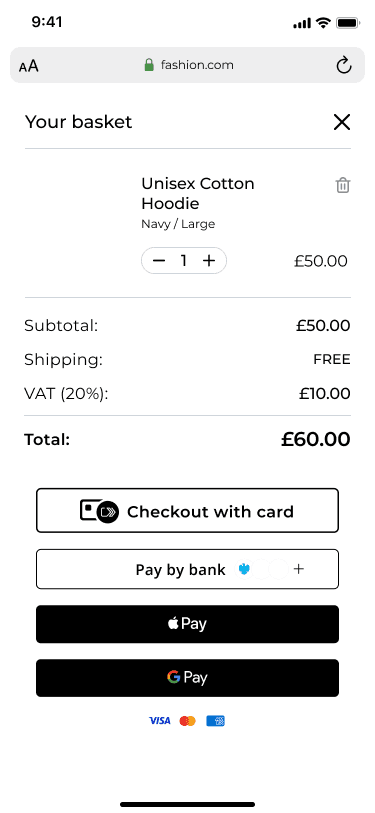
A generic “Pay by Bank” label asks a customer to interpret a new payment concept before deciding whether to trust it. I designed a country-specific button system instead: each market's button surfaces the three participating banks customers there already recognize. The bank logos aren't decoration — they're the adoption mechanism, doing the trust-building work that generic copy can't.
I evaluated a Visa-branded treatment, a generic bank icon, and a Tink-branded option before landing on centered “Pay by Bank” text with the local banks doing the convincing.
Same idea, six different markets
I extended the button system to every market in the planned rollout — UK, Ireland, Germany, Spain, France, the Netherlands — partnering with Tink and regional stakeholders market by market to validate which banks customers there would actually recognize, and rebuilding assets where the logos on file were outdated or missing. The result wasn't six one-off designs. It was one reusable localization framework for introducing a single global capability through signals that felt locally specific.
Prototypes that did more than show design
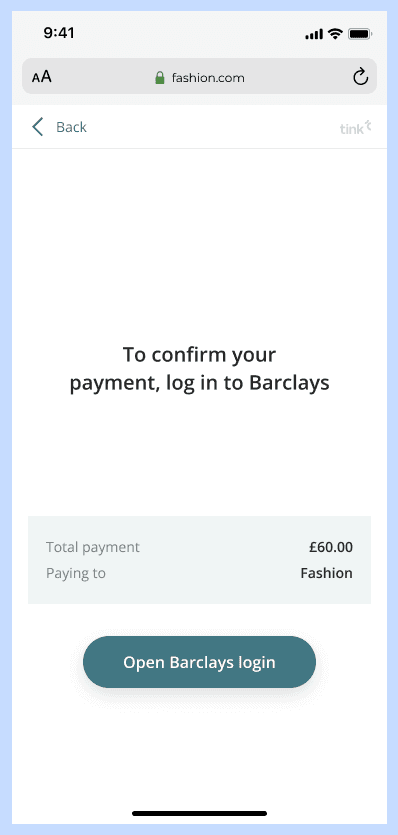
I built end-to-end mobile and desktop prototypes covering the full journey — payment selection, bank discovery, authentication, return to the merchant, confirmation, and every error and cancellation state in between. They became working tools, not deliverables: Product used them to define requirements, Engineering used them to scope implementation, and the work was used to demonstrate the future Tink and Unified Checkout experience directly to Barclays and other stakeholders before the integration was fully built.
When my primary Tink design partner was moved in a reorg, I rebuilt the relationship on the other side rather than let the work stall — staying accountable for the full experience even as the team around it changed shape.
Tink didn't get bolted onto checkout. It became part of it.